
What Is Disc Degeneration?
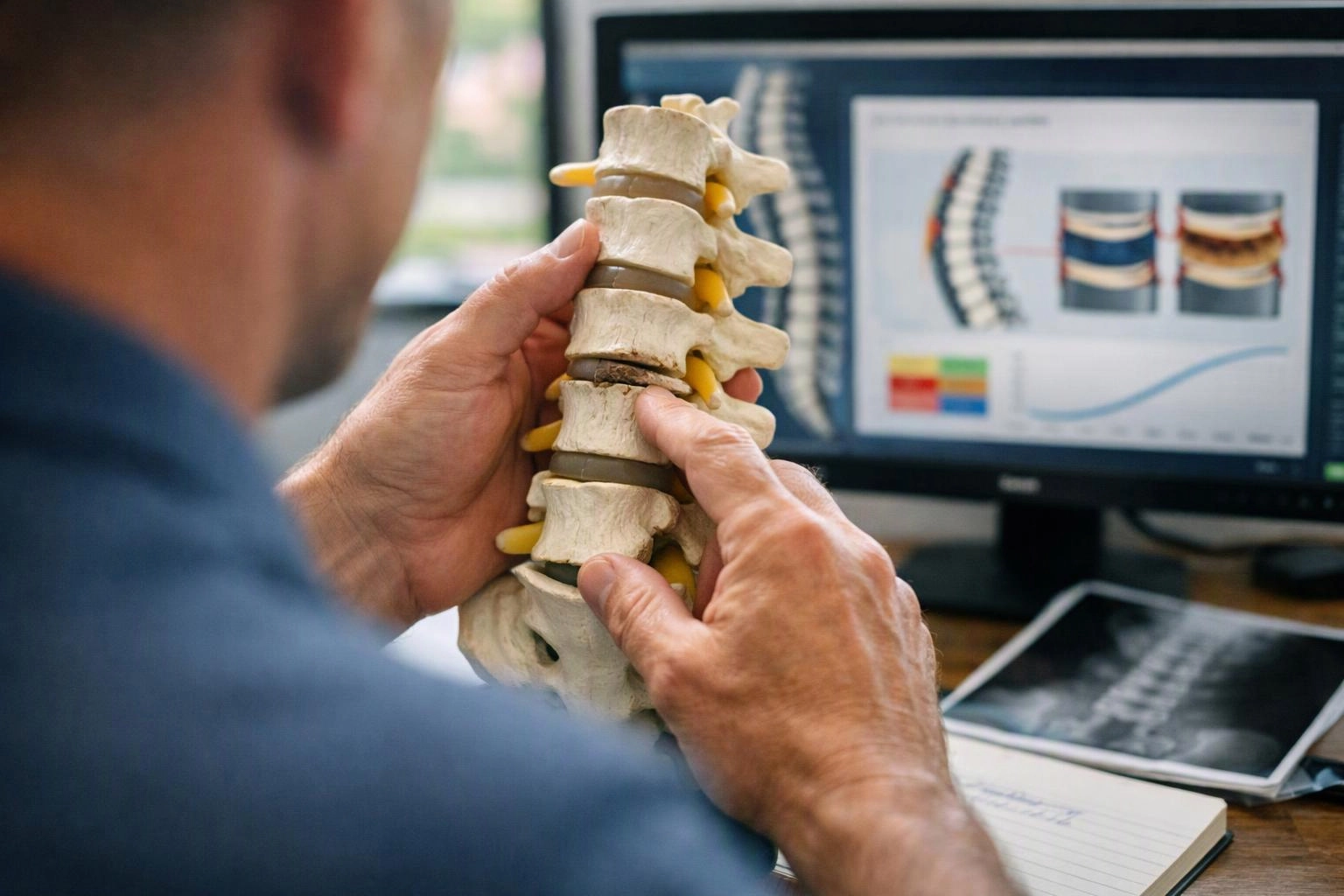
Disc Degeneration is a gradual change in the spinal discs that reduces their ability to cushion movement between vertebrae. The discs may lose water content, height, or flexibility over time. These changes can affect spinal motion and may appear alongside back or neck symptoms, although imaging findings do not always explain discomfort.
Quick Facts About Disc Degeneration
Category
Spinal disc condition
Used for
Understanding disc-related findings
Common confusion
Not identical to a herniated disc
Also called
Degenerative disc disease, Intervertebral Disc Degeneration
Often discussed with
Herniated Disc Treatment, Spinal Decompression Therapy
Key Takeaways About Disc Degeneration
- Disc changes can occur without causing symptoms.
- Movement and examination help place imaging findings in context.
- Disc degeneration is not the same as a herniated disc.
How Disc Degeneration Works

Disc Degeneration describes changes in the discs between spinal bones. A disc has a flexible outer portion and a softer inner portion. With repeated loading, aging, or injury, the disc can become less hydrated and less flexible. Its shape or height may also change, which can alter how nearby joints and tissues move.
Related glossary terms: Bulging Disc, Lumbar Spine, Cervical Spine.
Clinicians interpret these changes alongside your symptoms, movement patterns, strength, reflexes, and sensory findings. Imaging may show disc changes, but an image alone does not establish the source of pain. In Herniated Disc Treatment, the term helps distinguish broad disc wear from a focal bulge or tear that may affect a nearby nerve. A careful examination keeps the finding connected to the person’s actual function.
From the Arrowhead Clinic Chiropractic - Albany team
When we assess Disc Degeneration, we connect imaging findings with your history and physical examination. We check spinal movement, muscle function, and signs of nerve involvement before planning care. Our team treats the person’s current movement problem, not an imaging label by itself.
Disc Degeneration in Practice: A Real-World Example
A person with low back stiffness may have imaging that shows disc degeneration in the lumbar spine. During Herniated Disc Treatment, the examination helps determine whether the finding matches limited movement or signs of nerve irritation.
Related Terms
Bulging Disc
A bulging disc is a spinal disc that extends beyond its usual boundary as the outer…
Lumbar Spine
The lumbar spine is the lower section of the back, positioned between the thoracic spine and…
Cervical Spine
The cervical spine is the neck section of the spinal column, located between the skull and…
Arrowhead Clinic Chiropractic - Albany
Have Questions About Disc Degeneration?
Contact Arrowhead Clinic Chiropractic - Albany for practical guidance on Disc Degeneration and related chiropractor work in Albany.